Nameplates and Lettering
In the early industrial era, products were marked modestly, near the bottom, like so: “Mfg. Thos. A. Edison."
Soon the importance of brand identity and styling grew and coverged, giving the graphic arts the logotype. Known today simply as the “logo,” it is the signature of a product.
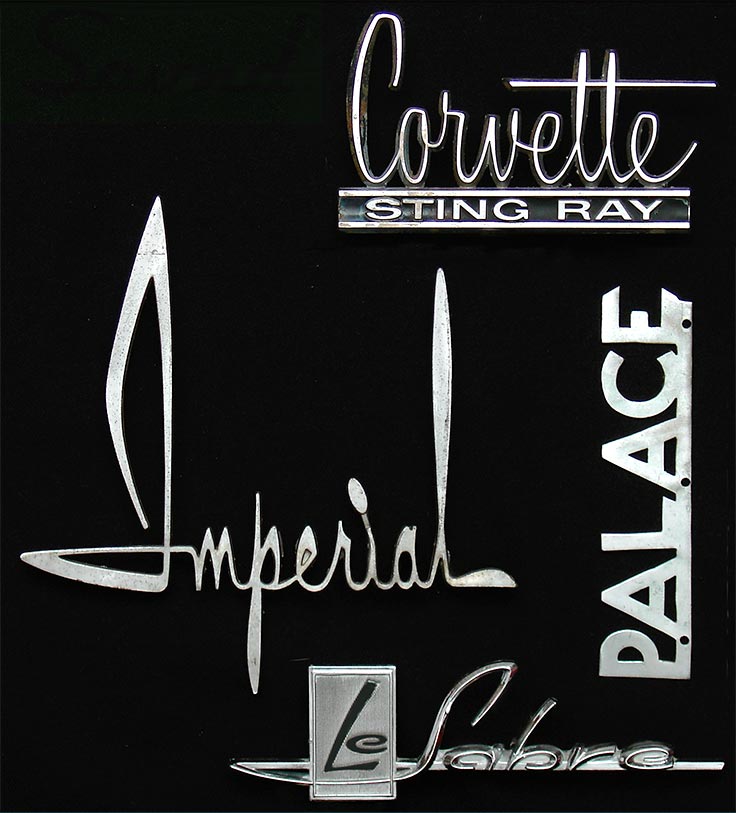
I especially like to collect nameplates that are primarily lettering, that is, are in the shape of the letters themselves. The designers’ challenge of holding such a nameplate together in a continuous piece (rather like neon) has produced many marvelous ‘signatures.’

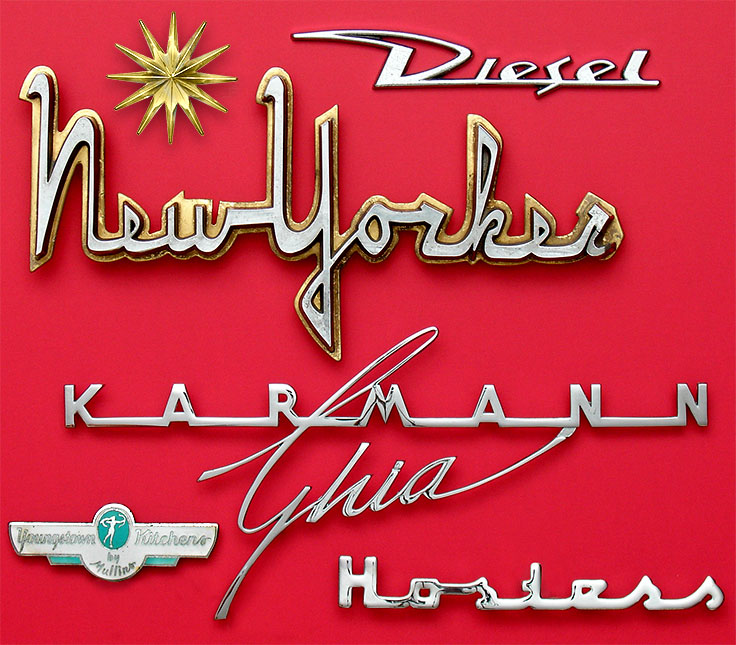
Many of the best were created for cars. Chrysler produced more than their share of great ones, including the New Yorker, Imperial, and Desoto examples you see here.
Also of note are Karmann Ghia from Volkswagen, Chevy’s Corvette, Buick’s LeSabre, and Diesel from Peugeot.
Among the nameplates here not in letter form, Youngstown Kitchens by Mullins is a nice example in cloisonné.
One technique highly-prized for its candy-like quality is “underpainted plastic,” sometimes called “reverse-paint plastic.” Examples here are the fabulous Coldspot nameplate (from a refrigerator) and the steering wheel buttons from Dodge and Chevrolet (Power Steering). In my collection of transistor radios, many of the best ones feature this delicious technique.
Palace comes from a mobile home/travel trailer, the triangular MW from some unknown product available at Montgomery Ward. Extremely expensive hi-fi equipment yielded this McIntosh example in a blackletter typeface and the world of sound equipment gave us Bell Sound Systems and RCA's Theatre Sound.
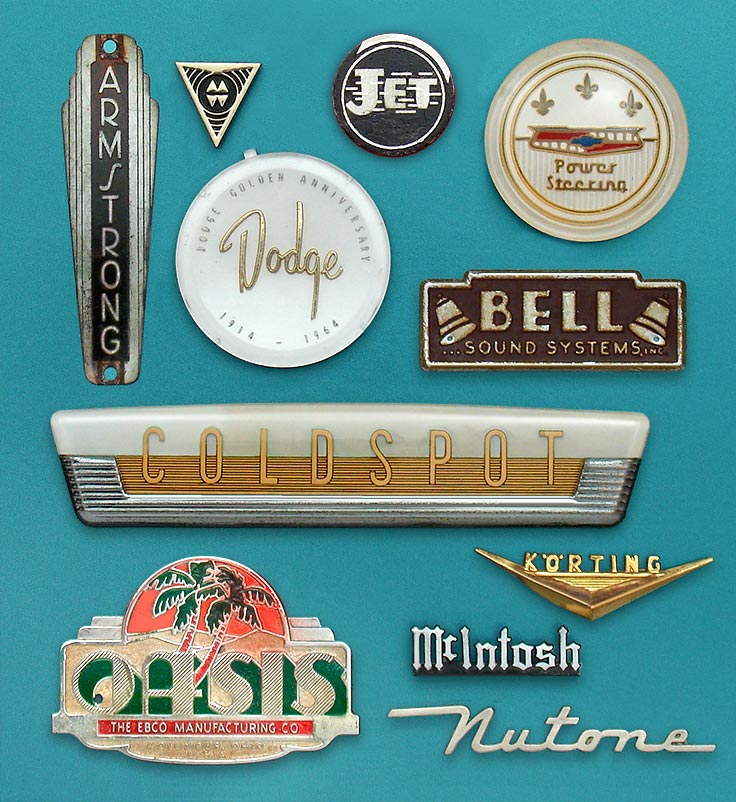
Oasis is from a water cooler. Nutone from a maker of doorbells and fans. Körting, a radio. The origins of Jet, Hostess, and Armstrong are a mystery.
Warning–Personal Story–safe to ignore: My father was one of the great TV-pounders of the 1950s. In those days a TV set came in a big wooden cabinet that needed a good slapping every now and then when the picture would start rolling, or jittering, or going dim. One day my father attached a large nameplate that read “Nomad,” to the front speaker grille of one particularly troublesome RCA Victor set we had. This lettering had come from an old Chevrolet, though I did not know that at the time. I asked him what “Nomad” meant and why he put that nameplate there on the TV. He said it was to remind him not to get mad at the TV set when the picture went out. No-mad. He was putting me on of course, but I believed him. I’m sure he just liked how it looked. And somehow he got away with it, my mother not knowing or caring what went on with the ‘technology’ aspects of the household. My lifelong interest in lettering probably got its start with that “Nomad” nameplate.

See the next page for more great nameplates and lettering. And there are lots of terrific ones at Richard Protzman's site. And still more at the groza.design site. How’s your Russian?