Why are forms so lousy?
In the mid-’70s, Larry Boden, a world-renowned disk mastering engineer, and I were commiserating on the sad state of forms. You know—any run-of-the mill, fill-in-the-blank forms. The spaces for short things are always too long and the spaces for long things are always too short. Larry especially wanted to create “The Perfect Tape Box Label” for his work as an engineer. And so we did.
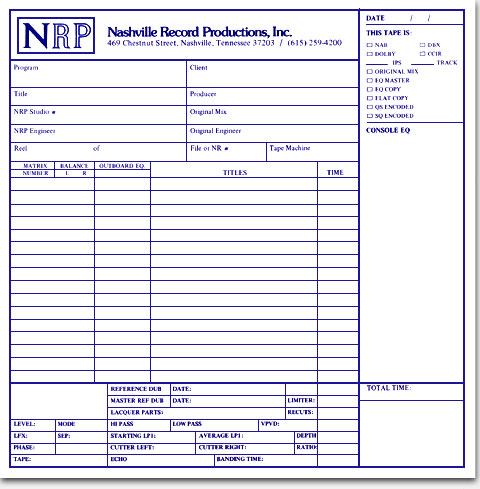
This was one of my earliest exercises in my technique of “idiot proofing.” I went back and forth with Larry suggesting all the things that could go wrong with filling out this label in various layout stages until we had wrung out every possibility and truly had the perfect tape box label.
Forms are very low on a designer’s status list. So low, in fact, that working on forms is almost universally considered beneath the dignity of any self-respecting artist. But I love working on them—clarifying, rearranging, and challenging the client to clarify his own thinking. There is far too little thought given to these information gathering workhorses and we’ve all suffered the consequences at one time or another. When you’re involved in making a form, remember that you’re in the business of communication and that the free flow of information both ways is essential. Using cryptic instructions and forcing people to cram things in or to put letters in individual boxes to meet the needs of the “machine” are all arrogant and dehumanizing. Spend the time and talent it takes to get these most basic forms of modern communication right and we all benefit, with better data and with increased compliance two ways—one, by showing the intended user you care about this communication in which you’re engaged and two, by showing the user you respect his/her needs. If you think concern for your communication partner is “beneath” you, shame on you.
What: Design, layout, art
For: Tape Box Label
Client: Nashville Record Productions, NRP, Nashville, Tennessee
When: Mid-’70s
©Copyright 2008-2020 ericwrobbel.com. All rights reserved.